How Net Metering Works in Florida and Why It Matters for Homeowners
If you’re considering solar panels for your Florida home, you’ve probably heard the term “net metering.” It’s one of the most important financial benefits of going solar — and understanding how it works can help you maximize your savings.
Here’s everything Florida homeowners need to know about net metering.
What Is Net Metering?
Net metering is a billing arrangement between you and your utility company. When your solar panels produce more electricity than your home is using at any given moment, the excess power flows back to the electrical grid. Your utility gives you a credit on your electric bill for that exported energy.
Later — at night, on cloudy days, or during periods of heavy use — when your home needs more power than your panels are producing, you draw electricity from the grid as usual. But instead of paying full price for all of that grid electricity, your credits from the excess solar production offset the cost.
At the end of each billing cycle, you only pay for the net difference — hence the name “net metering.”
How It Works in Practice
Here’s a typical day for a solar-powered Florida home:
Morning (6am–9am): Your panels start producing as the sun rises. Early morning production is moderate. Your home is using power for morning routines — AC, coffee maker, lights. Your panels may cover most or all of this usage.
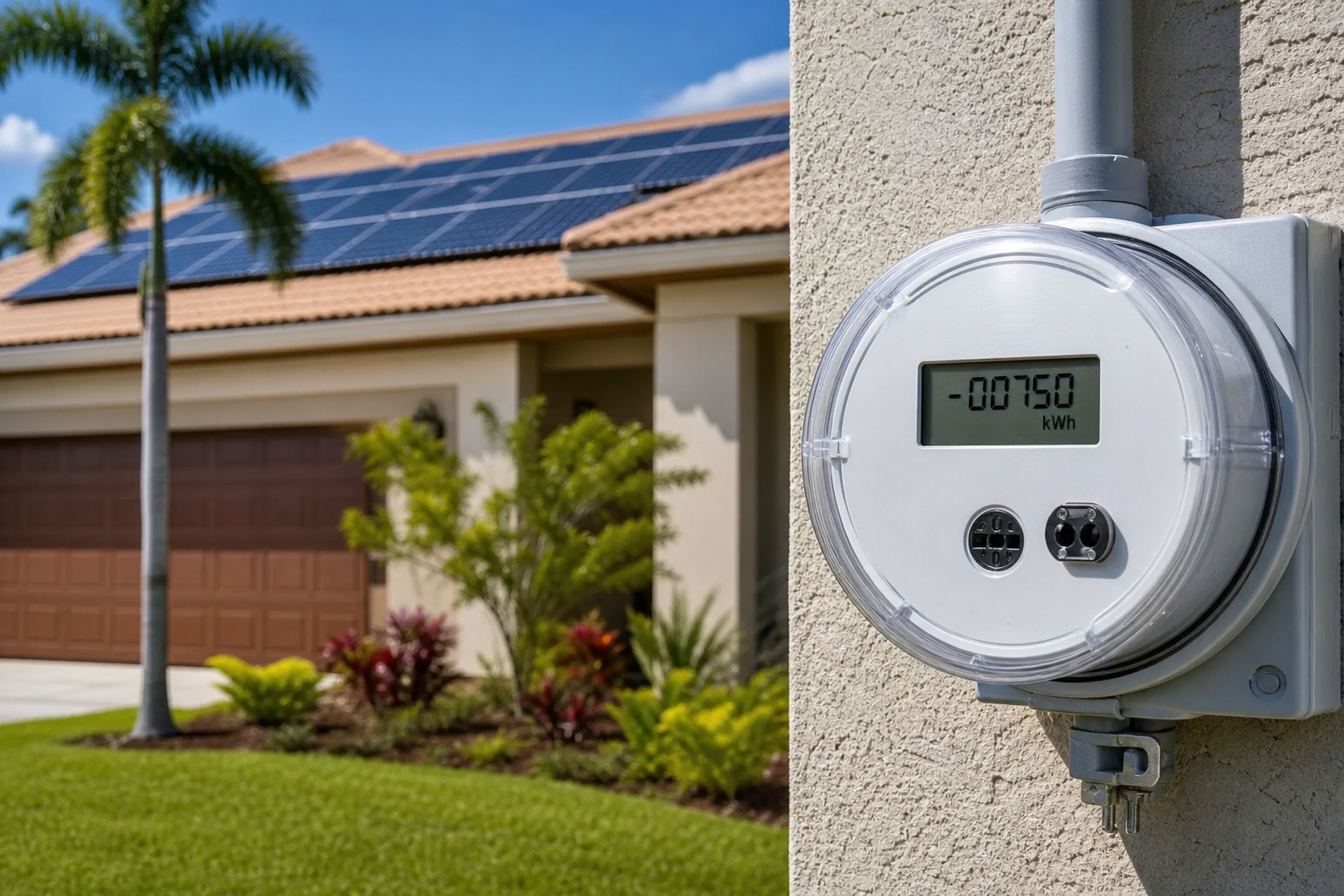
Midday (10am–3pm): Peak solar production. Your panels are generating far more electricity than your home needs. The excess flows to the grid and your meter “spins backward” — you’re earning credits.
Afternoon/Evening (4pm–10pm): Solar production decreases as the sun sets. Your AC is running hard in the Florida heat. You’re drawing power from the grid — but your credits from midday offset this usage.
Night (10pm–6am): No solar production. You’re fully on grid power. Your accumulated credits continue to offset the cost.
Which Florida Utilities Offer Net Metering?
Florida’s major utilities all offer net metering for residential solar customers:
- Florida Power & Light (FPL) — The state’s largest utility, serving most of South and East Florida
- Duke Energy Florida — Serving Central and West Florida
- Tampa Electric (TECO) — Serving the Tampa Bay area
- JEA — Serving Jacksonville
- Many municipal utilities and co-ops also offer net metering programs
Each utility has slightly different rules, credit rates, and enrollment processes. Your solar installer should handle the interconnection application and net metering enrollment as part of your installation.
How Credits Are Calculated
In Florida, most utilities credit excess solar production at the full retail rate — meaning each kilowatt-hour you export to the grid is worth the same amount as each kilowatt-hour you buy from the grid.
This is the most favorable type of net metering for homeowners. Some states have moved to less favorable arrangements (like paying only wholesale rates for exports), but Florida currently maintains retail-rate net metering.
Important details:
- Credits typically roll over month to month within a billing period
- Most utilities settle excess credits annually — meaning if you produce more than you use over the entire year, the excess credits may be paid out at a reduced rate or forfeited (varies by utility)
- You’ll still pay a small monthly grid connection fee ($10–$15) regardless of how much solar you produce
Why Net Metering Matters for Your Savings
Without net metering, you’d only benefit from solar electricity at the exact moment it’s produced. Any excess would be wasted — or you’d need expensive battery storage to capture it.
Net metering effectively turns the grid into a free, unlimited battery. You deposit excess energy during the day and withdraw it at night — with no storage equipment costs and no energy lost in the process.
For a typical Florida home, net metering increases the financial value of solar by 20–30% compared to a system without net metering access.
System Sizing and Net Metering Strategy
To get the most from net metering, your solar system should be sized to match your annual electricity usage — not exceed it by a large margin. Here’s why:
- Right-sized system: Your monthly credits roughly offset your monthly grid usage, resulting in electric bills near $0 (plus the small connection fee)
- Oversized system: You produce far more than you use. Excess annual credits may be forfeited or paid at a low rate — meaning you’re giving away free electricity
- Undersized system: You still pay for significant grid electricity each month. You save money, but not as much as you could
A good solar installer designs your system to maximize the benefit of net metering — producing close to 100% of your annual usage without significantly oversizing.
The Future of Net Metering in Florida
Net metering policies are always subject to regulatory changes. In 2022, a bill that would have reduced net metering benefits for Florida solar customers was vetoed by the governor. As of now, Florida’s favorable net metering policies remain intact.
However, solar industry experts recommend going solar sooner rather than later — most net metering agreements “grandfather” existing customers, meaning if policies change in the future, you’d keep the terms you signed up under.
Get Your Free Solar Evaluation
Net metering is a key part of what makes solar financially attractive in Florida. To see exactly how much you could save — with net metering credits factored in — schedule a free evaluation with us.
👉 Contact Direct Solar Point today to schedule your free solar evaluation. We’ll show you exactly how net metering works with your utility and what your monthly savings will look like.
Direct Solar Point provides honest, affordable solar solutions for Florida homeowners and small businesses. No high-pressure sales. No hidden fees. Just smarter energy.